Showing posts with label Opinions. Show all posts

Monday, June 15, 2020

Utah's History of Interracial Marriage

This year I learned that June 12th is Loving Day. Loving Day is the anniversary of the Supreme Court's decision in the Loving v. Virginia case to overturn marriage laws that prohibit interracial marriage. As someone who is in an interracial marriage, I felt intrigued to research Utah's marriage laws concerning race. 

Because Utah's early white history is intertwined with Church history, I had to grapple with some tough information about the opinions of early Church members, including prophets and apostles. My testimony of the gospel and belief in Jesus Christ has not been shaken, but I do acknowledge that what was said in the past was wrong. I also understand that those past opinions have influenced the culture of Utah and members of the Church in Utah today. Even though laws and policies have changed, some individual opinions and attitudes haven't, which has caused hurt and pain to many of Heavenly Father's children. To those who I have been hurt by past teachings and current attitudes, I am so sorry. 

The majority of this information I found by reading "The Prohibition of Interracial Marriage in Utah, 1888-1963" by Patrick Q. Mason (link at the bottom).

Pre-Utah Church teachings and events

According to journal entries, Joseph Smith taught that Blacks had souls and were "subjects of salvation." He talked about "equalization," but to him, it must have been a separate-but-equal idea because he also said that they should be confined to their own species. While mayor of Nauvoo, he fined two Black men who had attempted to marry White women. He fined one $25 and the other $5.

 In 1847, William McCary was a black man who was excommunicated for marrying a White woman, Lucy Stanton. The official report was that his excommunication was for polygamous marriages that were not approved by Church leaders. If these allegations of polygamy are true, it is also noted that all of his supposed wives were White, so it's not a hard stretch to consider the racial differences to be the main factor.

1852-1888 An Act in Relation to Service

Brigham Young continued the teachings against interracial marriages between Blacks and Whites. His words were quite bold in the fact that he declared those who did enter such unions deserved death, would loose access to the priesthood, and their children should not breed. Fair Mormon does point out, however, that Brigham Young never ordered the execution of any interracial couple, claiming that Brigham "had more bark than he did bite."

In 1852 the Utah Territory government passed the Act in Relation to Service, which prohibited sexual relations between Whites and Blacks. Such laws were largely accepted across the United States because several Supreme Court cases during that had clarified that both federal and local governments could constitutionally write and enforce laws concerning marriage. These laws were called anti-miscegenation laws, and were coupled with Jim Crow laws in the south and national anti-Chinese immigration laws.

Utah's law is viewed as peculiar to historians because most anti-miscegenation laws were in places where the Black population was at least 5%. Utah's Black population at the time was .3%. Historians believe that Utah participated in these laws because Utah newspapers shared stories of "scandalous" interracial marriages from other states. These stories, along with the attempts of racial equality during the Reconstruction era, led to the fear of "race mixing."

In 1884 a White soldier married a Black woman. The couple received public shaming via the newspapers and on the street.

In 1886 Thomas Colbourn, a Black man, was murdered, and a note was pinned on his body warning Black men to stay away from White women.

In 1887 A Black man and White woman were married in Salt Lake City. The ceremony was performed by a non-Mormon priest. The Salt Lake Tribune - anti-Mormon even then - blamed the Church for the marriage because the territory didn't have an anti-miscegenation law yet (the Act in Relation to Service was only about sex, not marriage).

1888-1963 An Act Regulating Marriage

Due to the above events and opinions, the territorial government passed An Act Regulating Marriage, which was signed into law March 8, 1888. This Act prohibited marriage between Blacks and Whites, Mongolians and Whites, polygamous marriages, incest, marriage "to an idiot", and underage marriages. During this time the federal government was breathing down Utah's neck about polygamy, and as an attempt to deflect, members of the Church tried to turn the spotlight on interracial marriage. However, at this point the federal government had already brought in non-members to Utah government seats, and polygamy was included in the Regulating Marriage Act. 

An important note to make here is that marriage to Native Americans was not included, though other states and territories surrounding Utah did include Native Americans in their prohibition laws. Historians believe this is because the culture of the Church believes that Native Americans are descendants of the Lamanites from the Book of Mormon. This belief created an encouragement to marry "Lamanites" in order to save them. By 1870 about three dozen white men had taken Native American Wives. However, white women were discouraged from marrying Native American men. Another possible reason that Historians have mentioned is that by the 1880s Native Americans had already been segregated from White Utah residents, so the risk of "race mixing" was low. 

In 1889 a family living in Logan was turned into the authorities for being mixed. The husband was Chinese and the wife was White. They had been married in Idaho before Utah's law was put into affect, but the authorities still took their children away.

In 1895 a White woman was denied a temple sealing to her White husband, because she had previously been married to a Black man and had two children from her previous marriage. 

On November 16, 1897 George Q. Cannon wrote in his journal  that he had learned from John Taylor, who had learned from Joseph Smith, that a White man who marries a Black woman would lose the priesthood, and they should die.

In 1898 an Ogden couple was caught in bed after midnight and arrested. William Howard was Black and Ella Howarth was White. Ella tried to claim that she had a Black ancestor, so their relationship was valid. After being put under pressure, Ella admitted that she was full White. She was sent home, and William was sentenced to 20 years in prison.

Also in 1898 Dora Harris and Quang Wah applied for a marriage license in Salt Lake City. They were denied because Quang was Chinese. Dora argued that she was part Black on her mother's side. The county clerk denied that claim, saying that her skin was so light that her White lineage dominated and he declared her White.

In 1907 B.H. Roberts wrote in defense of segregation because it would prevent the mixing of Whites and Blacks by marriage. During the priesthood ban, at least two White men were denied the priesthood because they married Black women - not to mention all Black men were denied the priesthood. The Young Women's journal advised young women of the Church to avoid marrying outside of their race or they will be committing "race disintegration" and "race suicide."

1939 Additions to the Marriage Regulation Act

In 1939 there was an attempt to segregate Black neighborhoods in Salt Lake City. The attempt failed because a group of Black women went to every meeting and made their voices heard.

Also in 1939, further prohibitions were made to the Marriage Regulation Act:
  • Those with syphilis, gonorrhea, and epilepsy 
  • Malay with White
  • half black, one-quarter black, and one-eighth black with White 
The decision to include those of Malaysia and Indonesia heritage came from a case in California where a Filipino-White couple argued for their right to marry because Filipinos are not of Mongolian descent. 

In 1946 J. Reuben Clark counseled the young women to marry within their race, because the opposite, according to him, is both biologically and spiritually wrong. Most Church leaders during this time preached against interracial marriage - with the focus being against marriages to Black people.

1963 Repealing the Marriage Regulation Act

Starting in 1948, individual states started to repeal their anti-miscegenation laws. Idaho did so in 1959, which inspired James Thomas (Black) and Kathleen McMurtrey (White) to travel to Idaho to get married. They had already been living together, and had a baby. Though due to extreme pressure from Kathleen's family, they had given the baby up to a children's agency. After their marriage they returned to Utah and asked for their baby back. Their marriage was denied, as was the request to return their baby. The official reason was that Thomas' divorce from his first wife had not been finalized, it was not finalized until 1960. However, it is without a doubt that Thomas' skin color played a bigger role in the denial. 

As Utah watched the rest of the country, they figured that it was only a matter of time before the Supreme Court made a national decision, and decided to repeal the Marriage Regulation Act on their own in 1963. One Republican representative vocally opposed; stating that the children and grandchildren of such unions will be denied eternity because they would inherit the "curse" from their black ancestors. 

The exact wording of the law:

Utah Code Title 30 Husband and Wife, Chapter 1 Marriage, Section 2.2 Validation of Interracial Marriage

"All interracial marriages, otherwise valid and legal, contracted prior to July 1, 1965, to which one of the parties of marriage was subject to disability  to marry on account of Subsection 30-1-2(5) or (6), as those subsections existed prior to May 14, 1963, are hereby valid and made lawful in all respects as though such marriages had been duly and legally contracted in the first instance."

Afterwards

Although the law had changed, racism among Church members did not. In 1966 a White woman was denied future access to the temple after she married a Black man, and was told that her endowments were now invalid. She appealed to higher leadership, and her living endowments were validated, but the ban from the temple remained. 

When the priesthood ban for Black men was lifted, the Church spokesman at the time clarified that interracial marriage was still discouraged. President Spencer W. Kimball also further explained that while interracial marriage was not a sin, it was still discouraged and considered selfish because of the hardships that both the couple and their future children would endure due to cultural differences.  

In 1995, a talk given by Russell M. Nelson had a footnote that stated that marriages will be most successful when both spouses are of the same religion, language, culture, and ethnic background.

In both 2003 and 2008, the Church was put in a position to clarify that it no longer has any restrictions on interracial marriage. And in 2013 the teacher's manual for the youth was updated, and the Spencer W. Kimball quote about marrying within one's race was removed. In fact, I searched the Church's website for Spencer W. Kimball's teachings on marriage, and I cannot find this quote. 

In both 2007 and 2017 the Deseret News published articles talking about the rise of interracial marriage across the nation (links at the bottom). These articles stated the following statistics:

  • 2000 poll shows that 62% of Whites support interracial marriage.
  • 2005 4% of the nations couples are interracial.
  • 2017 1 in 6 newlyweds are interracial, with support among Whites increasing.
Both articles also shared several individual stories about interracial couples in Utah.

Personal Thoughts

The above research shows that Utah's laws against interracial marriage was directed towards Blacks and Asians. Hispanics were never mentioned. Though one of the Deseret News articles stated that Hispanic-White marriages have only just begun to be recorded as interracial marriages in recent years, so that might be one reason why. A theory of mine is that in Church culture, Hispanics fall under the "Lamanite" umbrella like Native Americans; so members want to "bring them into the fold." It is also noteworthy that the census records for 1920 show 1.2% Hispanic for the entire U.S., no data for Hispanics for 1930, and 1.5% for 1940; so it is also likely that the number of Hispanics living in Utah at the time was not concerning when the Regulation Act was amended in 1939. However, regardless of the law, the culture of racism most definitely has seeped into how some White people in Utah view and treat Hispanics. 

I would also like to mention that this research showed me that the records focused on White marriages to persons of color. As a few of the stories mentioned, one person of color from one race marrying another person of color from a different race was acceptable. I do think it's important to point out that those marriages are still interracial marriages. Just because they both have darker skin, doesn't mean there aren't cultural, and sometimes linguistic differences. A White person does not have to be involved to make a marriage interracial. 

I do believe that Utah's history with racism has influenced the experiences I have had while dating men of color. I have not dated any Black men, and I know the current conversation is about racism against Blacks specifically; but I would like to share my experiences in order to compare with the experiences shared by White-Black couples in Utah. My point will be made clear soon. I promise I am not trying to change the spotlight.

One of my boyfriends from my teenage years was Polynesian. Some members of his family did not like him dating a White girl, and that led to a fast breakup. His family did not openly tell me that, he never told me that, one of his friends told me privately. Another boy, whom I did not date exclusively, we tried to start a relationship and it didn't work out, was Hispanic. One of his siblings told me that their dad did not know I was White. In both of those instances I felt very hurt and offended. I never met either of those parents, so no face-to-face interactions took place. Because of that, I'm not going to be so audacious as to claim any form of racism or prejudice on their part. I just would like to point out that that is only two instances for me of feeling that way. People of color get that multiplied by at least a thousand. They experience stuff like that all the time.

During this time I had a conversation with a co-worker, who was Native American, about interracial relationships. She expressed disapproval and said, "I'm sorry, but you white women steal our men!" This comment has stuck with me since, and I always feel validated when I see a woman of color with a white man because then things are balanced, and marrying Gerson was okay.

My next boyfriend was also Hispanic, and his stepdad and step-sisters were White. I had a really good relationship with his family, and spending time at his house was fun and comfortable. After him, I dated my one and only White boyfriend. When our relationship "became public," one person who was voicing their approval said, "And Chelsey, he's White!" I'm embarrassed to say that I laughed in response. At the time I thought that they were just teasing me because I did have a habit for dating "brown boys." However, when that same person voiced bold disapproval for me dating Gerson, that comment came back to haunt me.

During Christmas of that year, Gerson went home to spend the holiday with his family. He told his mom that he wanted to marry me and that he was going to propose in the near future. His mom told him, "I'm sad that I won't get to talk to my future daughter-in-law." Gerson responded, "I'm not going to marry a Latina just so that you can talk to her." I wasn't offended by that statement. Being able to converse with your family is a valid desire. So, I took that as my cue to learn Spanish, and I registered for a Spanish class the following semester. Gerson's mom has also practiced English, and we currently communicate in broken Spanish and broken English, and really love each other. 

When Gerson and I got engaged, several people thought I was pregnant. The questions and comments depleted my self-esteem because I thought that I was fat and that's where the comments were coming from. It was Gerson who set me straight, "You're not fat. No one can understand why a 19 year old White girl is marrying a 25 year old Hispanic man. Pregnancy is the only thing that makes sense to them."

Throughout our ten year marriage we have had mostly positive experiences. When we encounter something negative though, we have to go through the whole alphabet of "what ifs" and "maybes" before we admit and accept if something was racist. Gerson experiences more racism when he is out and about by himself than when he is with me. A small list off the top of my head:

  • While walking to our car at BYU, a White girl, who was walking ahead of Gerson kept looking back at him with a fearful expression, and eventually broke into a run. (I wasn't there.)
  • Car dealerships always try to overcharge him.
  • Employees at Panda Express and Cafe Rio almost always assume we are separate and look surprised when we are paying together.
  • One time at Dillard's in the shoe department, the Sales Associate, who was Hispanic, would sigh and roll her eyes every time I asked to try on a shoe (Gerson was with me); but had no problem being friendly and helpful to the other couple in the department who were both Hispanic. 
  • A police officer pulled Gerson over and accused him of having "stolen plates" on his car. Gerson told the officer that this was the only car he had ever owned and the plates were not stolen. The cop took Gerson's info and went back to his car, when he came back he claimed there must have been a glitch because now the info showed Gerson's plates matched his registration.
  • A sales associate at Verizon assumed that neither Gerson nor I could do math, and was very condescending the entire time we were renewing our contract. 
  • A stranger called the police on Gerson, claiming that Gerson was driving drunk. While waiting for the police to show up, the stranger tailed Gerson in their own vehicle, scaring Gerson. The police officer who responded was very nice and figured out immediately what was going on, and apologized to Gerson.
  • While parked on the side of a residential road, an old White man banged on Gerson's car window and yelled, "What are you doing in this neighborhood."
  • When playing Pokemon Go at the park, it is not uncommon for White moms to pull their children closer as Gerson walks by.
Why did I include negative experiences with other persons of color? One, because I would be sharing an incomplete story if I didn't. Two, the opposition to interracial relationships can be found on all sides. I would like to make it clear that I do not consider Gerson's conversation with his mom as part of this. I shared that to show the the cultural differences that people who oppose interracial marriages are so concerned about are not something to shy away from. We meet them head on and work together in patience, love, and acceptance.

When it comes to identifying my children, I am very adamant that they are White-Hispanics or White-Latinos. I want them to be proud of and be accepted by both races. We are able to claim this because their skin is a light tan. Biracial people who have darker skin tend to have a harder time claiming their White race. The comedian Trevor Noah said that the only people who are allowed to be White are the people who look White. Mixed people with darker skin have to label themselves as the colored part of their heritage. Trevor grew up in South Africa where there is White, Black, and Colored. In South Africa Trevor is Colored, here he is Black. Either way, he is not allowed to own his White heritage, which is really sad. We need to allow biracial people to label and identify themselves the way they choose to that isn't dependent on the hue of their skin. 

Over the past few weeks I have read several personal experiences from Black people, some who live in Utah. Compared to what they have experienced, Gerson's run-ins with racism are tame. But neither are okay. I encourage everyone to read up on the experiences of Black people, and ask yourself if you have done anything similar to the examples in their stories. Before I married Gerson, I made a lot of mistakes, and I still do. He has been patient with me, and I have learned a lot from him. Listen. Learn. Change. 

Sources:

https://www.jstor.org/stable/45063125?seq=24#metadata_info_tab_contents


https://www.deseret.com/2007/4/13/20012735/mixed-marriages-on-rise#susan-and-mitsuyuki-sakurai-an-immigrant-from-japan-have-been-married-30-years-it-has-been-40-years-since-the-u-s-supreme-court-struck-down-laws-against-interracial-marriages-utah-repealed-its-law-against-such-marriages-in-1963


https://www.deseret.com/2017/5/18/20612565/50-years-after-supreme-court-ruling-interracial-marriage-has-increased-but-varies-by-location#file-richard-p-loving-and-his-wife-mildred-pose-in-this-jan-26-1965-file-photograph-residents-of-caroline-county-virginia-the-lovings-married-in-washington-d-c-in-1958-upon-their-return-to-virginia-the-interracial-couple-was-convicted-under-the-states-law-that-banned-mixed-marriages-they-eventually-won-a-u-s-supreme-court-decision-in-june-1967-that-overturned-laws-prohibiting-interracial-unions-ap-photo


https://le.utah.gov/xcode/Title30/Chapter1/30-1-S2.2.html?v=C30-1-S2.2_1800010118000101


https://en.wikipedia.org/wiki/Interracial_marriage_and_The_Church_of_Jesus_Christ_of_Latter-day_Saints#19th_century_teachings_on_black-white_marriages


(I know that wikipedia is not the most credible source. However, the reason I linked it is so that the teachings from past Church leaders are in one comprehensive list. I double checked that each one I mentioned links to a more official and credible source.)


Monday, August 19, 2019

Lessons from Junie B. Jones

Benjamin finished kindergarten earlier this year, and throughout the school year we read the Junie B. Jones series. I loved the series when I was young. My favorite is Junie B. Jones is a Party Animal. I grew up going to and hosting sleepovers, but I never had one quite like that! Benjamin and Luna have thoroughly enjoyed the series - so far we have only read the Kindergarten ones. We'll read the first grade ones this up coming school year. It has been really interesting hearing Benjamin's reactions to the situations that Junie B. finds herself in. He points out when any of the characters are making bad choices or being mean, and I have helped him identify when they are being nice.

As an adult and a mom reading the series this time, I noticed some parenting/teaching lessons that I missed as a kid. There are a few times where Junie B. does in fact make a choice that warrants the discipline that she receives - like when she cuts her stuffed animals and her own hair, or when she colors on her graduation gown. Barbara Park helps the reader know when Junie B. knows that she is making a wrong choice by having Junie B. use language (Junie B. is the narrator) like "sneaky" and "quietly" to describe her actions. 

However, most of the time, Junie B. is just reacting to the circumstances around her. She still needs guidance and correction, but I don't think she needs to be yelled at by her teacher or parents as often as she does. In fact, reading the series has made me check how often I yell at my kids - I'm not perfect at it, but I'm working on it. Which, I think, might have been Barbara Park's intentions. I really love how Junie B's grandpa Frank Miller and the school principal treat her. They are both so patient with her, and they aren't as put off by her little quirks the way other adults in her life are. They are great examples on how to interact with children.

Like any series,  the side characters - Junie B's classmates - really bring the stories to life and teach great lessons about kindness and friendship.

Grace is, in my opinion, the kindest kindergartner in Room 9. She's honest and tells it like it is, but she rarely gets angry nor misbehaves. I think her character is a great role model.

Lucille is a product of her grandmother's spoiling. Honestly, she is not kind, but at that age it isn't her fault because her grandmother raised her that way. Junie B. and Grace are friends with Lucille regardless of her less than gracious language towards them. They will defend themselves when they need to, but I like how they constantly turn the other cheek and continue to play with Lucille. At the same time, however, Benjamin has had friends that, like Lucille, are
not consistently nice to him or others. It got to the point where I told Benjamin that he had two choices: walk away from that kid and no longer play with them, or shrug it off.  With the exception of a few incidents that absolutely needed to be addressed, Benjamin - bless his heart - chose to shrug off the mean things that kid would do and continue playing with them. I was honestly hoping that Benjamin would choose to walk away from that friendship, but the important thing is he made the decision that he wanted to make. I didn't make him stay friends with that kid.

"cry baby William" as Junie B. calls him, is the Neville Longbottom of Junie B. Jones. He is scared of everything, and cries easily. This time reading the series, I saw Benjamin in William. Benjamin has anxiety, and my heart was softened towards William as I saw the similarities between my own son and this character. Then, in one of the last books of the kindergarten series, Junie B. Jones is Captain Field Day, William gains his entire class's love and respect when he is able to do pull ups on the monkey bars when no one else is able to for the field day activities. He is a perfect example to not judge on the outside, and to give everyone a chance. I love William.

"meanie Jim" sent me two strong messages in two different books. In Junie B. Jones and Meanie Jim's Birthday, Jim invites every kid in his class to his birthday party except Junie B. He gets in trouble with his mom and the principal, and is forced to give Junie B. an invitation. On the day of the
party, Junie B. is on her way to his party when she changes her mind and she goes to her grandparents' house instead and spends the day there. Even though she wanted an invitation, she didn't actually want to go to his party because he is mean to her. The weeks leading up to Benjamin's birthday I felt stress if I should invite the whole class. There seems to be a collective attitude online that you either invite the whole class or don't invite anyone. I knew I couldn't spend the money it would take to host his entire class, and we didn't have room in the small apartment we lived in at the time. I decided to ask Benjamin who he wanted to invite, and wrote down the names that he said. He chose to invite six boys from his class. I asked his teacher what her rules were on birthday invitations, and she said that it was best to come the last five minutes of class. She said some kids would get their feelings hurt, but it was okay. I'm glad she had that attitude because I agree, we aren't going to get invited to everything, and it's important to learn that early. Now, in Junie B.'s situation, it is wrong to invite all but one, but it's completely okay to invite a few and not the rest. Three kids in Benjamin's class did express disappointment in not getting invited. I remained silent and let Benjamin handle it, and he kindly said, "Maybe next time."

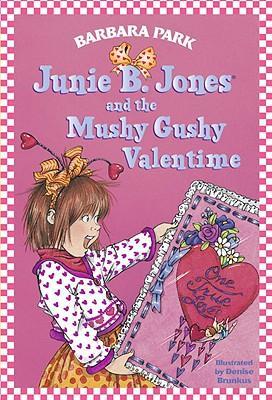
In Junie B. Jones and the Mushy Gushy Valentine, Junie B. receives a Valentine gift from a secret
admirer. It turns out that the valentine is from meanie Jim! Junie B. is understandably surprised, he has been mean to her the whole school year. She asks him why he is so mean to her if he likes her. Jim tells her that she makes school interesting, and it wouldn't be interesting anymore if everyone knew, so he asks her to keep it a secret and act like nothing has changed. She agrees. This plot fits right into "boys will be boys" and "he's mean to you because he likes you." Which, of course is a big no-no in today's society. Something interesting that Barbara Park does is she neither condones nor condemns Jim's actions with her words in that book or future books, but her silence in future books sends a clear message. In all of the books after  the Mushy Gushy Valentine, Junie B. never mentions Jim's feelings for her. He's still meanie Jim, and she continues to defend herself. As the narrator, Junie B. never reminds the reader that her fighting with Jim is just for pretend so the class doesn't know he likes her. I think that tells us what Barbara Park thinks of that kind of behavior, and what she wants Junie B. to think of it too: that it's not okay, and therefor not worth giving attention to.

I highly recommend reading the Junie  B. Jones series to your children. Today was Benjamin's first day of first grade, and I can't wait to start reading the Junie B. Jones first grader series!

Friday, April 5, 2019

My Mighty Change of Heart: My Journey to Accepting My Brother's Sexuality

Most of you know that I am an active member of The Church of Jesus Christ of Latter-day Saints. Many of you also know that my brother, Michael, is gay. Unfortunately, some of my responses have not been best, but my heart has recently changed; and I say better late than never.

Michael came out to me privately on December 30, 2013, and he came out publicly on January 2, 2014. I struggled for the first few years. I never stopped loving Michael, I never looked down on him, and I never viewed him as lesser. But I did feel sad for him, and I felt sad watching him go on a rollercoaster trying to figure out where he fit in in the world and in the Church. I struggled and felt conflicted with what and how I wanted to teach my children about Michael's sexuality while remaining steadfast in the gospel. And I struggled with how to navigate my testimony of the doctrine on the family, and how to best support Michael. Do I allow my children to meet his partner(s)? If Michael gets married, do I attend his wedding?

I also felt hurt and angry that my parents had known for years and I had been kept out of that knowledge until 3 days before Michael told everyone else. Michael and I are the only children our parents have, and I am the older sibling. If I had been the younger sibling I could understand not telling me. If we had more siblings I could also understand not telling me. But I was literally the only person in my house who did not know. I did know something was going on. I knew private conversations were happening. And it hurt that it was kept from me. In the past six months Michael and I have been able to heal from those years of secrecy, and we are fine now.

In the beginning, I encouraged Michael to find a woman who he could be best friends with and marry as a best friend. I encouraged this because I thought that was what he wanted, and early on that is what Michael communicated to me that he thought he wanted that. When he changed his mind, it took me longer to get on board. I just wanted Michael to find a way to be happy living the gospel the way I was living it. I wasn't trying to be harmful, everything came from a place of love.

I started to see some cracks in my thoughts - and people who share the same thoughts - when one of Michael's singles ward bishops tried to put Michael through a disciplinary council, and possible excommunication. I'm not going to go into a lot of detail because it's not my story to tell. Michael's stake president put a stop to it and said no, that Michael did not need to be put before a disciplinary council. It broke my heart to hear that someone viewed my little brother like that.

I also started to question if I was going about this correctly when I heard some people say, "I don't go to family events if my gay cousin is there with their partner because I don't want my children to see that." My passive, non contentious side said nothing, but on the inside I was screaming, "When it's your sibling or your child it is so different! If I did that, I would never see my brother."

I also can't support attitudes that believe we need to be constantly preaching against LGBT lifestyles. Believe me, they know the Church's teachings. They don't need weekly reminders. I'm not going to lecture Michael every time he goes on a date. We all need to get to the point where we step back and respect individual agency. If the family is the most important aspect of the gospel, then contention due to the exercise of agency is not going to help with a loving family atmosphere.

My dad has been inactive for 14 years. A few years ago I told my mom how angry I was at dad. My mom told me that if I'm angry instead of loving, how will my dad ever view the Church positively? Michael is the same. How is he supposed to feel loved by members of the Church, if all we do is lecture him on his lifestyle?

In addition to all of this, I'm not going to criticize the leaders of the Church. I'm not going to demand changes to doctrine. I still have a testimony of the Church of Jesus Christ and his gospel. There are some things I don't understand. I still have struggles with certain topics and information. But I have faith that answers will come. I have faith that everything will eventually work out. And I have faith that following the prophets, even amongst human mistakes, will bring blessings.

In the past year I have received several personal revelations on how to improve my relationship with Michael. I have told Michael that he is welcome to talk to me about men that he is seeing. I have told him that we will welcome anyone he might want to bring to family dinner. So far we haven't met anyone yet, but the openness is there.

Recently, Heavenly Father has prepared me ahead of time for certain announcements and statements made by Church leaders. Thoughts and inspiration will come to me and then not too long after, something will be said that matches my personal revelation. This recently happened with the updated baptism and apostasy policies.

A few weeks ago while questioning - for the umpteenth time - if it would be okay to attend Michael's possible future wedding, I received the inspiration to view gay marriage the way I view a member to a non-member marriage. My sister-in-law married a man who is not a member of the Church, and we love and accept him. I can view Michael's potential spouses the same.

Then, the first Presidency announced:

"At the direction of the First Presidency, President Oaks shared that effective immediately, children of parents who identify themselves as lesbian, gay, bisexual or transgender may be baptized without First Presidency approval if the custodial parents give permission for the baptism and understand both the doctrine that a baptized child will be taught and the covenants he or she will be expected to make.
A nonmember parent or parents (including LGBT parents) can request that their baby be blessed by a worthy Melchizedek Priesthood holder. These parents need to understand that congregation members will contact them periodically, and that when the child who has been blessed reaches 8 years of age, a Church member will contact them and propose that the child be baptized.
Previously, our Handbook characterized same-gender marriage by a member as apostasy. While we still consider such a marriage to be a serious transgression, it will not be treated as apostasy for purposes of Church discipline. Instead, the immoral conduct in heterosexual or homosexual relationships will be treated in the same way.
The very positive policies announced this morning should help affected families. In addition, our members’ efforts to show more understanding, compassion and love should increase respect and understanding among all people of goodwill. We want to reduce the hate and contention so common today. We are optimistic that a majority of people — whatever their beliefs and orientations — long for better understanding and less contentious communications. That is surely our desire, and we seek the help of our members and others to attain it."

I believe that my personal inspiration matches what was announced at the leadership conference. I'm not trying to say that I receive revelation for the Church. But I very strongly believe that God does speak to me, and the changes I have made to help my brother feel more loved and welcome were inspired by God.

A few years ago Elder Uchtdorf said,

"That Day of Judgment will be a day of mercy and love—a day when broken hearts are healed, when tears of grief are replaced with tears of gratitude, when all will be made right.

Yes, there will be deep sorrow because of sin. Yes, there will be regrets and even anguish because of our mistakes, our foolishness, and our stubbornness that caused us to miss opportunities for a much greater future.
But I have confidence that we will not only be satisfied with the judgment of God; we will also be astonished and overwhelmed by His infinite grace, mercy, generosity, and love for us, His children. If our desires and works are good, if we have faith in a living God, then we can look forward to what Moroni called “the pleasing bar of the great Jehovah, the Eternal Judge.”
This quote has helped give me peace for my family being less than perfect in our religious circumstances. It allows me to step back and breathe. It has helped me respect the agency of others, while still living my beliefs. My family is sealed together, and everything will work out for us. I don't know exactly how things will work out, I simply have faith that they will.

I know now that I can share my testimony while giving Michael room to breathe and figure things out for himself. I need to respect his agency. But I also don't regret many of the things I have said and thought because I can't change the past and it was part of my learning and growing. Some things I have apologized to Michael for, and that's between us, and our relationship is strong and loving.

I'm sure some of you are feeling appalled at some of the things you have read in this post. Why couldn't I have just supported him right away? Because I am human, and therefore am imperfect. I have imperfect human emotions and feelings, and I am allowed the time to navigate them and figure it out for myself.  I think it's extremely hypocritical to try to encourage change and when someone does to fire back with "You should have never thought that in the first place! Too little, too late!" It's more important that I got here eventually, than getting her perfectly. And I would appreciate my past not being held against me.

On the reverse side, I am not breaking temple covenants, ignoring the doctrine, nor encouraging sin. I am loving my brother the way that I have been inspired to love him. I still believe the Church is true. I believe the leaders are chosen by God. And I believe in personal revelation.

Because I believe in personal revelation, I don't think that what I have shared is a one-size-fits-all solution to this complex topic. Other families may receive different answers, and that's fine. I just wanted to publicly share my love and support for my brother Michael.

Tuesday, January 15, 2019

Princess Mononoke and the Right to Live

*Disclaimer: Everything I say about this movie is from a Western-Christian point of view. I am in no way trying to speak for the original intent of the writers and producers.

Once a week my brother and I try to get together and watch a movie. We take turns picking and introducing each other to our favorites. My brother is a huge fan of Studio Ghibly (we grew up loving Kiki's Delivery Service), and he has picked his top favorites to show me. So far we have watched (in this order):

Castle in the Sky (Loved!)
Spirited Away (Terrified me, never again.)
Howl's Moving Castle (It was enjoyable, but I had some problems with it.)
Princess Mononoke (LOVED!)

The basic story line of Princess Mononoke is that humans are destroying the forests for industrialism, and the spirit animals (called gods) are at war with the humans to protect the forests. The main character, Ashitaka, comes from a distant village and is unaware of the conflict until he accidentally finds himself in the middle of it. Lady Eboshi is the leader of Irontown where they dig up iron for profit and cut down the forest for building. San, a human who was raised by the the wolf god, helps the wolf clan fight the humans and protect the forest. Ashitaka, as a stranger and outsider, is not emotionally attached to only one side, and wants everyone to coexist peacefully.

In this movie, hate has the power to become a literal demon within those who allow hate to grow in their hearts (mixed with some other stuff, but I'm not going to give the whole movie away). Hate encourages both humans and animals to kill. Ashitaka tries to convince both humans and animals to let go of their hate, stop killing, and live. The Great Spirit, also called the Night Walker, represents a Creator being, and is in charge of both life and death. He is supposed to be the only being in charge of creating life and taking it away.

Due to my Latter-day Saint background, I couldn't help but notice a similarity between Heavenly Father and the Great Spirit, and Hate and Satan. The Great Spirit is all seeing and all knowing, and is the only spirit/god to see Ashitaka for who he really is (the other gods fear and hate him simply for being human).The Great Spirit has a few moments of saving characters who have not reached their time, and allowing others to die when it is their time. Hate encourages killing of the "other," greed, and anger. Ashitaka seems to be the only character who truly understands that the Great Spirit is supposed to be the only being in charge of life and death, and it's that message that got me thinking about hate, life, and death in the real world.

Heavenly Father is the creator of life, and it is supposed to only His power to take earthly life away. But as Satan encourages hate among mankind, we end up killing each other and sometimes ourselves - this killing can be literal or emotional, fast or slow. Here are some common ways in which mankind kills:

  • Murder
  • Abortion
  • Neglect
  • War (Of course, there are times where war is necessary)
  • Suicide (I understand suicide is very complex, and I know I am not an expert. I am not judging anyone who has taken their life or attempted to take their life, and I know that God knows what is in their hearts.)
  • Over eating/under eating
  • Over exercise/under exercise
  • Seeking perfection
  • Harmful words against others or oneself
  • Working too much/not working enough
  • Judging others or oneself
I'm sure more can be added to the list.

We need to let go of our hate for others or ourselves and live. Heavenly Father blessed us with life, we can thank Him by living our best life. No, we won't be completely free from trials, pain, and temptations, but we can use His help to overcome them or live through them, and find joy. No, I'm not perfect, and I'm not trying to look down on anyone. This movie simply touched me very deeply and I wanted to share my feelings about it. My hope and goal is to start ask myself when I am making a decision, "Does this decision allow myself and others it affects to live?"

If you have seen the movie, I would love to hear your thoughts about it. If you haven't seen the movie, watch it! It is so good!


Sunday, August 19, 2018

Opposites attract, and that's okay, right?

Almost every morning, I read a chapter in the scriptures and an article in The Ensign while I eat my breakfast. Recently, I read an article titled "Choosing Whom to Marry" by Scott R. Braithwaite, who is an Associate Professor of Psychology at BYU. Since I am already married, I didn't think the article would teach me much, but I still read it because I read each issue of The Ensign cover to cover.

Professor Braithwaite has studied divorce predictors. One such predictor stood out to me:

"Do birds of a feather flock together, or do opposites attract? That is, do people have healthier marriages if they are similar to one another or if they have differences that complement and balance out areas of weakness? Answers to questions about people are often complex, but in this case there is a clear answer: the more alike two people are, the more stable and satisfying their marriage. “Birds of a feather” for the win!"

I consider Gerson and I opposites that attracted each other. Gerson's strengths are math and science, while mine are history and English. I was a competitive ballroom dancer, and he was a video gamer when we met. I'm a bookworm, and Gerson hates reading. There are very few movies and TV Shows that we both like, and we do not like the same music at all. In fact, one of the biggest fights we had before we got married was about the musical groups Tool and The Backstreet Boys. On top of all of that, Gerson and I grew up in different cultures, and spoke different languages at home.

So when I read the above paragraph, I felt frustrated. No, I don't think Gerson and I will ever get divorced  - we are not even close to going down that road; but I felt like I had to defend my marriage to myself.

Professor Braithwaite goes on to explain that the reason why couples who are similar have easier marriages is because they are able to spend more time and energy on enriching their relationship rather than reconciling differences. At this point I wrote in the margins, "How opposite is opposite?" The next sentence in the article answered my question, "This principle is especially important when it comes to matters of faith."

Okay, so Gerson and I are actually fine! Both of us wanted a temple marriage. Both of us had similar goals and ideas about children and how to raise them. Both of us have the goal of reaching the Celestial Kingdom. Yes, we do have some minor differences in our way of living our religion, but we are committed to each other, and having the same big goals along with our commitment makes working through minor differences easier and worth it.

The rest of the article I felt validated my marriage to Gerson. Professor Braithwaite recommended that people stop looking for their soul mate, because soul mates don't exist. I do agree to a point. I have never believed that there is only one person for each of us. What if there was and the one person meant for you made choices that led them away from you? That wouldn't be fair to you.

However, I do believe that Gerson and I knew each other in the preexistance, and had a close relationship. I believe that our spirits recognized each other when we met, because the pull I felt towards Gerson was not immediately physical, but spiritual. I know that's not the same thing as a soul mate though.

Professor Braithwaite wrote that we choose our spouse. Gerson and I definitely chose each other. There were a few outside forces that did not want to support our relationship, but we were committed and didn't let those forces win. We still are committed.

Professor Braithwaite also suggests that instead of creating a list of the ideal partner, we develop the attributes ourselves that we would want our spouse to have. I never had a list, which I'm sure helped me fall in love with Gerson so quickly and easily. I have always loved him for who he is, not who I want him to be.

At the end of the article I wrote, "Gerson and I are similar in the important things, and opposite in the less important things." Have some of our opposites created roadblocks in our marriage? Absolutely. But we had already decided that we were committed to each other. We love each other way too much to let his video gaming or my desire to bring dance back into my life every once in a while (among our other opposites) break up our family. Two years ago our marriage was really tested, and we got through it and came out on top! We are stronger because of it.

I'm sure other people didn't overanalyze this article the way that I did. But I think that marriage advice is a lot like parenting advice: you accept the pieces that fit with your family, and shrug off the ones that don't. I sometimes feel the need to validate my marriage because I'm scared of others judging my marriage. That's simply an insecurity that I am dealing with. But I know that I don't need to feel that way, and I'm working on not being so self conscious about how other people view my family.

Gerson and I are two opposites who fell in love and got married. And despite our opposites, we are in a happy, loving, and stable marriage.


Friday, July 6, 2018

Nonconsensual Immorality, What I Wish I Had Known

In a recent general conference, Elder Quentin L. Cook condemned rape, sexual assault, etc; and put it all under one term: nonconsensual immorality.  He said, "It is commendable that nonconsensual immorality has been exposed and denounced. Such nonconsensual immorality is against the laws of God and society."  Elder Devin G. Durrant shared something his dad said, "You have strong hands, son. I hope your hands always have the strength to never touch a young lady inappropriately."


Hearing those two men condemn sexual assault made me think about my own experiences. Especially what I know now that I didn't know then, that would have helped during the emotional and psychological aftermath.

I have been sexually assaulted three times in my life, one of those times does not apply to the focus of this post, so I won't be talking about it. The other two happened when I was 14 years old and again at 17 years old. I'm not going to go into a lot of detail nor am I going to name the young men, because that is not what I want to focus on. I want to talk about the lack of knowledge, support, and help surrounding the assault.

I have healed from the assaults, and I have forgiven the - at the time - young men who harmed me. Although I have forgiven, I will not forget these experiences, because looking at them with more knowledgeable eyes has influenced how and what I teach my children.

When I was 14, I went on a summer study abroad trip to Australia and New Zealand. While on that trip a boy a year older than me touched me inappropriately. I told one of the girls in my group; her response: "That's not a big deal. I've let guys touch me like that before." I didn't tell anyone else after that. I had bad dreams related to the incident for about a year afterwards.

What I knew at the time:


  • The way he touched me was against the law of chastity.
  • He wasn't LDS, so he didn't know anything about the law of chastity.


What I did not know at the time:


  • Because I did not consent, the way he touched me is considered sexual assault and is against the law.
  • Just because some people are OK with that kind of physical touch, does not mean society should expect all people to be - You see, the way that girl responded made me feel like I was overreacting. I thought that my discomfort in being touched like that was because of my religious upbringing, so I didn't tell any of the adult leaders because I was only one of two LDS people on the trip.


When I was 17, a guy that I let kiss me touched me inappropriately. I told him no, he didn't listen. I tried to physically push him away, he still didn't listen. I went to my bishop to confess and repent (I incorrectly thought that because I had consented to the kiss, I was responsible for everything that happened after). My bishop recognized what had happened, and instead of banning me from taking the sacrament and taking away my temple recommend  (two things I thought would happen), he invited and encouraged me to go on my ward's youth temple trip the following week, and he recommended that I not spend time with that particular boy again - something I was more than happy to agree to do. I struggled with anxiety and depression for the next several months.

What I knew at the time:


  • The way that boy touched me was against the law of chastity.
  • He was LDS, but thought that sex was the only sin that broke the law of chastity, so he did not think that he did anything wrong.


What I did not know at the time:


  • Because I did not consent, the way he touched me is considered sexual assault and is against the law.
  • Consenting to the kiss did not make me responsible for him not respecting when I did not consent other stuff.
  • I did not sin.


The reason I am talking about this now is because I believe that when I was a teenager, the youth were not taught enough about sexual assault and how it affects them as innocent children of God. Growing up, the law of chastity was taught in a very one sided way: it's all up to me to make sure that I don't do those things, and that I don't let anyone do those things to me. I was not taught that I was not responsible for boys/men's thoughts, words, and actions. I was not taught that if someone touched me without my consent, it is against the law. Now, I still love and respect my youth leaders, I do not think they sent me those confusing messages on purpose. I think they were just following what was in the lesson manuals, and examples from their own pasts.

I also want to take this moment to explain that my parents tried very hard to teach me self worth. I do not think that they failed me. When I was 13 years old and started attending co-ed events, my Dad told me that if a boy ever made me uncomfortable with his attention, to call him and he would come get me no matter where I was and no matter what time it was. Of course, neither of us anticipated that the time I would need him was when I was halfway around the world.

In the Church published lesson manual Gospel Principles, the chapter on Chastity (Ch. 39) teaches parents how to teach their children about their bodies, the law of chastity, and procreation:

"Parents can begin teaching children to have proper attitudes toward their bodies when children are very young. Talking to children frankly but reverently and using the correct names for the parts and functions of their bodies will help them grow up without unnecessary embarrassment about  their bodies.

Children are naturally curious. They want to know how their bodies work. They want to know where babies come from. If parents answer all such questions immediately and clearly so children can understand, children will continue to take their questions to their parents. However, if parents answer questions so that children feel embarrassed, rejected, or dissatisfied, they will probably go to someone else with their questions and perhaps get incorrect ideas and improper attitudes.

It is not wise or necessary, however, to tell children everything at once. Parents need only give them the information they have asked for and can understand. While answering these questions, parents can teach children the importance of respecting their bodies and the bodies of others. Parents should teach children to dress modestly. They should correct the false ideas and vulgar language that children learn from others.

By the time children reach maturity, parents should have frankly discussed procreation with them. Children should understand that these powers are good and were given to us by the Lord. He expects us to use them within the bounds He has given us."

I have tried very hard to follow this counsel as I have potty trained my kids, as I have bathed them, and as they have asked questions. I do think that when it comes to how much a parent teaches their child at a given age is up to the discretion of the parent. We know what our individual children can understand and handle, and so I don't think there is a set-in-stone rule on what to teach our children at what age. There are just general guidelines to give parents an idea. Without going into too much detail, Benjamin and Luna know the proper names for their own and the opposite genders body parts. They have been taught the basics of breastfeeding. They know what pads, panty liners, and tampons are (the joys of living in a 1 bathroom apartment). They have a very surface level understanding of how Lily was born, and they know that they grew inside my body before they were born.

We have a rule in my family: You cannot make someone do something they don't want to do. It's kind of wordy, but it's the words my kids currently understand. It applies to everything: physical touch, toys, make believe, eating. It applies to everyone: Benjamin, Luna, Mom, Dad, Lily, Grandma, Grandpa, Uncle Michael, friends, etc. My kids are being taught to respect the word No. They are also being taught that the word "stop," angry screaming, and crying are other ways to communicate "No." This is how I am teaching the basics of consent to my children.

Here are two frequent examples:

Benjamin wants Luna to play in their room, Luna wants to play in the living room. Benjamin grabs Luna's hand and tries to pull her into their room. Luna screams. I intervene and tell Benjamin that he cannot make Luna do something that she does not want to do. I ask Luna where she wants to play, she answers the living room. I tell Benjamin that Luna is going to play in the living room, he can play in their bedroom. When they both want to play in the same room, they can play together again. Depending on the day, sometimes B&L play on their own in separate rooms, sometimes Benjamin stays in the living room, and sometimes Luna eventually joins him in their room. But the main point is neither one of them can make the other play where they don't want to.

Luna wants to kiss everyone before her nap. Benjamin went through a time where he did not want to kiss her goodnight. Luna would scream and try to make him. I would tell her, "You cannot make Benjamin do something he does not want to do." She would ask him for a hug, and he would agree to hug her goodnight.

In all incidents like the two examples above, my children are taught that they cannot force someone to do something they don't want to do; and at the same time they are being taught that they cannot be forced to do something they don't want to do. They are allowed to say no, and defend themselves.

I am not perfect. There have been times where I don't like how I responded to something my kids did or said. But, just like we teach kids it's ok for them to make mistakes, it's also ok for parents to make mistakes; as long as we correct them. I do believe that I am on the right path with my kids in teaching them about their bodies. I hope that we continue with a good relationship so that they continue to ask me questions and believe the answers I give them.

Back to the incident in which I went to my bishop, I told one person before I went.  I didn't go into detail, I just said that I had to talk to the bishop. They asked why, but I wouldn't tell them. They told me that they were disappointed in me. That made me cry. I'm not mad at that person. I love them, and I know they love me. I believe they were trying to teach me the seriousness of what they thought had happened; but I was refusing to talk. If I had told them, who knows where the conversation would have gone. I have learned from that, and if/when it's my own kids I want to handle the situation differently. If they don't want to tell me, I am going to respect that, but I will not tell them that I am disappointed in them. I will try to use the Spirit to say something like, "I will not make you tell me, but I want you to know that you can tell me and I will listen without judgment.  I will love you and comfort you. I hope that you have a good talk with the bishop and that you can feel the Spirit and Heavenly Father's love. I encourage you to listen for inspiration on what to do to move forward."

Based on conversations with other parents who have children my age, I have faith and hope that this upcoming generation of youth will have a better understanding of chastity, repentance, forgiveness, and consent; and how those principles work together. I have faith and hope that we can raise some pretty amazing stripling warriors for the last days.

Wednesday, September 6, 2017

Five Meal Planning Tips

Every once in a while I notice facebook posts asking for dinner ideas. Not new recipes for a future date, but ideas for dinner that night. So I thought that I would share how I meal plan each week and hopefully help a few friends out. 😊

1. Recipe Organization

I'm not very good at just picking and choosing what to make for dinner. So my recipe book is organized in a way to choose for me.

When I got married my mom gave me a copy of her personal cookbook. It's printed pages in page protectors in a three ring binder. (That burn mark was not planned, but it sure looks cool!) Her recipes come from Betty Crocker, Kraft, and friends and family members. I have taken away and added to it over the years as well. It's divided into sections according to food type. The two sections I use weekly are: Meats and Main Dishes and Salads. Each dinner I choose a Main Dish and a Salad (fruit or vegetable, sometimes both). The Main Dishes are organized by Beef, Meatless, Chicken, and Pork (there was a fish section originally, but Gerson doesn't like fish).  The recipes in each section started out alphabetical, but as I've taken away and added, they are now just in the order in which they were received.

When I plan meals, I go in the order that they are printed in my cookbook. I have about double the number of beef and chicken recipes than I do meatless and pork, so my order pattern is: beef, meatless, chicken, beef, chicken, pork... Depending on how many servings a recipe makes, I generally make 2-4 dinners a week.

2. Visible Menu

Being able to see my planned menu out in the open makes it easier to plan for it and keep to it.

I used to write 5-7 meals on a lined peace of paper and stick it to my fridge, and as I would make one I would cross it off. Then as I memorized how many meals a dish would feed us for, and better scheduled our evenings, I started planning specific meals for specific days on my lined piece of paper. I would cross each day/meal off as we completed it.

I eventually got tired of using up lined paper. So, with the help of Pinterest, I made a weekly menu board in which I can write my meal plans with dry/erase marker. All it took was a picture frame,
decorative stationary and stickers. It sits on my kitchen table. Gerson likes having a visible menu as well because it helps him better plan his lunches and snacks at work.

3. Grocery Shopping

Having a set time to go grocery shopping and a written list has been very helpful for me.

I go grocery shopping at the end of each week for the next week - or do Walmart Pickup depending on how busy my week has been. I use my recipe book to plan my meals, then I write my shopping list. For fresh items, I buy them for that week. For canned and boxed items, I buy for my food storage rotation. And it's all based on the ingredients in my planned meals, that way I don't buy anything that won't get eaten. Of course, things get missed and I have to go back to the store, but that's why I start to prepare my meals the night before.

4. Prep up to 24 hours before

Looking at the menu and double checking the ingredients and instructions the night before helps make meal prep the next day easier.

Almost every night after I clean up from dinner, I look at the menu for the next night. If anything is frozen that needs to be thawed, I put in the fridge the night before. Also, if anything needs to be prepared earlier in the day - like a crockpot meal or a jello salad - then I write it down on my daily to-do list so that I don't forget and leave it too late. I also try to make sure I have all of the ingredients needed, and if not I have time to make a quick run to the store.


5. Set rules for new recipes 

If you are like me, you are constantly collecting new recipes. Setting rules as a family about new recipes will benefit everyone who eats at your dinner table every night.

I used to make a new meal once a week, but that became too much for Gerson. So now I only make a new meal every other week to once a month. I also avoid making new meals while I'm pregnant (of course I'll break that rule if something looks really good!). I also have what I call the three strikes rule. When I make a new meal and we don't love it, but it has potential, I'll make it again and change what I didn't like. I'll change it one more time if needed before I scrap it. Off the top of my mind, my baked Ziti recipe has benefited from this rule.

Obviously I don't perfectly keep to my menu 100% of the time. Stuff pops up in our schedule, the kids or pregnancy does something to inhibit me making dinner, etc. But having it all prepared does make it easier, and I just move all our meals over a day if something does happen. I hope this post was helpful! Following these tips has really helped my meal planning and prep be less stressful.

Sunday, October 9, 2016

Why I'm Voting for Evan McMullin

On Wednesday October 5, 2016 I attended Evan McMullin's event at the Provo City Library. I have been following him since two days after he announced his candidacy. Evan is a breath of fresh air in this joke of a presidential race. The purpose of this post is not to go into the strategy details of how he could win - by a huge miracle I might add. I'm not going to quote that "lesser of two evils" quote. I'm not even going to tell you that you should vote for Evan, because that is your decision to make. I'm going to tell you why I am personally voting for Evan McMullin.

What would eventually lead me to choose McMullin over the other candidates started during the primaries. My choice during the primaries was John Kasich. I knew his chances were low but I still liked him best, and I was happy to support Ted Cruz when Kasich dropped out. But when Ted Cruz dropped out I felt unsure on what to think. Honestly, I simply could not believe that Donald Trump was the Republican nominee.

I went back and forth: Hilary Clinton or Donald Trump? I thought, well Hilary has experience. I might disagree on some fundamental things, but at least she knows what she is doing. Then when I heard Mike Pence speak at the RNC, I thought, Oh I can vote for Pence by voting for Trump. Pence is an actual conservative politician. Maybe with him and other real Republicans guiding Trump, a Trump presidency could be okay. But like with Hilary, there are fundamental issues that I can't stand behind.

I know a lot of people think that Trump haters don't want to vote for him because he's rude, obnoxious, and quite frankly, a complete lunatic. Yeah, he is all of those things, but so are practically every other politician out there - they are just better at hiding it. I'm not voting for Trump because I disagree with his immigration reform plan, his tax reform plan, and some of his ideas on religious freedom. I disagree with his actual policies, it's not just me disliking the person the media has painted.

I also cannot stand behind Hilary with her stance on abortion (a.k.a. "reproductive rights"). Nor her idea that psychologists and psychiatrists shouldn't be allowed to help transgenders learn to love, accept and stay comfortable with the person and body they were born  with (I promise I didn't make that up, it's on her campaign website). Obviously if someone chooses to take hormones and have surgeries, that's their choice. but not even give them and their doctors the option to choose? That doctors can only offer hormones and surgeries?  That's going too far. But this topic is for another conversation. I also don't agree with their tax plan.

As you can see. I actually researched both Hilary Clinton's and Donald Trump's campaigns. My decision has nothing to do with the media hype, and everything to do with their policies that I simply cannot support.

I decided to research the 3rd party candidates, and still found disappointment. Jill Stein and Gary Johnson are too liberal for my taste, and Darrel Castle is simply too weak, and his financial ideas are confusing and scary. At this point I planned on writing in Mitt Romney's name. Then Evan McMullin made the news. I decided to look into him, but I wasn't expecting anything. When I finished reading his campaign website evanmcmullin.com  I knew I was voting for him. (I also follow his facebook page.)

Evan's stance on immigration and abortion match mine exactly. He agrees the border needs to be secured, but he also knows deporting 11 million people is ridiculous. He would like to see Roe v. Wade overturned, but he also understands that the whether abortion is legal or not is one of many answers to this problem. In one of his earlier interviews he said most liberals and conservatives both want to see abortion numbers go down, we are simply head locked in the legal aspect of it. But if we asked and answered the question together, "How can we make abortion numbers go down?" and worked together on that, we would be more productive.

While he believes that marriage is between one man and one woman, Evan will not fight the Supreme Court on the recent decision about same-sex marriage. He is going to respect their decision. I know that's a hard pill for many conservatives to swallow, but I agree with him. I think it's a waste of time and money - precious money - to fight it. That doesn't mean that us individual conservatives stop teaching our children what is right, but I think the legal fight is over for now.

 He wants to lower and simplify taxes - though I haven't heard if he has a plan with actual numbers yet. His idea of liberty and freedom fits all races, religions, and classes. You see, when Republicans talk about freedom, they mean freedom for Christians. When Democrats talk about equality, they mean equality for the LGBT groups. Evan wants equality for all, true equality. In his address at the Provo Library he said, "With liberty for all, we will have different skin colors.  With liberty for all, we will have different religions."

A lot of people think that he is a spoiler, that he is handing the election to Hilary. But he's not doing this to be self-serving. He's not being malicious. In a recent interview as well as at the Provo Library event he said that he approached big name conservatives first. He wanted to create a campaign to back someone with name recognition. All of them declined. At this point his team asked him if he would step up, and he agreed. And now here we are.

I know it will take a HUGE miracle for him to win. I'm not so naive to think this will be an easy journey. But his campaign is more than just a bid for the White House. His campaign is creating a new conservative movement, a movement that could very well create a new conservative party. The Republican party is a sinking ship, and if Hilary Clinton wins - which she has a very good chance of doing so - I believe the Republican party will crumble. Conservatives who have already abandoned ship can create a new and better conservative party to rise in its place.

I also have to vote for who and what I believe in. I don't believe in Donald Trump or Hilary Clinton, and I don't believe in the parties they represent. I don't believe in being a strategy voter. I believe in voting my conscious, and my conscious says Evan McMullin.

Tuesday, September 27, 2016

The Growing Division Among Women and Who is Behind It

As women - as human beings - we naturally separate ourselves by our differences and gather together by our similarities. We feel good being surrounded by people who are in similar circumstances as us; and feel judged, inadequate and scared of those different from us. Some common divisions are: being single, being married, being a mom, not being a mom, being a SAHM (Stay-At-Home-Mom), being a working mom, breastfeeding, formula feeding, home births, hospital births, feminists, non feminists... you get the picture.

Depending on which social circles you run in, certain groups are painted as "the mean girls" of that aspect of life.  Moms are often accused of judging women who are not mothers, women who breastfeed are accused of judging women who formula feed. But the reality is that every "group" feels judged by their opposite "group". Single women feel judged by married women, and vice versa. Women who are not mothers feel judged by those who do, and - believe it or not - women who are moms feel the same way. SAHMs feel judged by working moms, and working moms feel judged by SAHMs. Once, again, you get the picture.

While there are real mean girls in each "group" that say and do terrible things, most of the time, hurt feelings were not intended. A mom can't express how much she loves being a mom without being told she's hurting the feelings of women who are not moms. A SAHM can't express how much she loves staying home with their kids without being accused of making working moms feel guilty. A breastfeeding mom can't express the bond she feels feeding her child without being called a nipple nazi. Formula feeding moms can't share which brand of formula helped their baby without fearing getting that dreaded "breast is best" comment. Women who are single and/or childless by choice can't voice that fact without getting overwhelmed with all of the "you're missing out" comments. It's gotten to the point where no one can say anything to anybody without offending somebody. So because of this, we stay in our groups, and we don't branch out, and we think those "other" women are the mean girls.

Do you want to know who is behind all of this? Satan. Satan knows that dividing us strengthens him, because we can't defeat him by ourselves. He turns differences into insecurities, insecurities into hurt feelings, hurt feelings into anger, and anger into hate. How are we supposed to raise our families correctly if we are surrounded by so much negativity? We can't. Then our children are raised in a divisive environment, and they continue this cycle of division. And he does this to more than just women and mothers. He does this to everyone, dividing us along the big lines (race, religion, class, politics) as well as the little lines (neighborhoods, interests, talents, life styles).

Now, this does not mean that Satan "makes" us do and say mean things. It does not mean that people who do and and say mean things hold no accountability - they do. It simply means that he plants that negative seed, and the more we water it, the more power he holds over us. You see, we either water the seed of faith, or the seed of Satan's lies.

 If you find yourself critiquing someone's circumstances or correcting their choices, stop it! If you find yourself feeling judged by someone who is simply expressing joy about their own life, take that seed away from Satan and chuck it! You have the power to do so! God gave you that power in the Garden of Eden when He put enmity between Satan and Eve and gave us all the power to "bruise thy (Satan's) head". (See Moses 4:21 and Genesis 3:15)

So, take that negative and divisive power away from Satan by not feeding into it. Look for the similarities, and don't run from the differences. In fact, embrace the differences. People like to say, "focus on similarities, not differences". But if all we look for is similarities, then when differences come up we don't know what to do with them. We need to celebrate the differences, not stifle them. So look for both, and embrace both. We need to accept that there are different ways to live, different ways to raise a family, and that is okay. We also need to be willing to turn the other cheek if someone is being disagreeable about that, because the only person we can change is ourselves. Change has to be a choice, it can't be forced on anyone or it will not be successful.

We are all children of God, and we need to remember that. Not only do we need to remember it, but we need to teach it to our children, our friends, our neighbors, to people we don't even know. We all want to survive this scary world, and we can't do it alone and divided, but we can do it united.


Sunday, December 6, 2015

It's Okay If All You Can Offer Is A Prayer

In the past few weeks there have been several responses to the tragedies across the world. One of the more popular responses is to pray for those affected by violence and hate. And as people have shared their prayers on social media they have either been condemned and told that praying is not enough, or they have been mocked and told praying doesn’t make them a hero. Either way, the advocacy for prayer is being diminished in a time when it is needed the most. I want you to know that it is okay if all you can personally offer during these tragedies is a prayer for peace, comfort, and love.

Maybe some of the anger at the prayer posts is because they are misconstrued as something to say in order to look compassionate. I want you to know that when I say “my prayers go out to…” I truly am praying for them. I am not saying that in order to get likes or follow the current social media trend. I am truly getting down on my knees and asking Heavenly Father to send love and comfort to the family members of the victims in Paris, San Bernardino, and other parts of the world. I am truly asking Heavenly Father to heal those who were injured. I am truly asking Heavenly Father to wrap His arms around those who are struggling and help them. Even when I don't announce it online, I am still praying. That is what I can do right now, and I will not be shamed and bullied into thinking that my prayers are worthless. After all, are we not commanded to “mourn with those that mourn”?

Mosiah 18:8 …and now, as ye are desirous to come into the fold of God, and to be called his people, and are willing to bear one another’s burdens, that they may be light;

9 Yea, and are willing to mourn with those that mourn; yea, and comfort those that stand in need of comfort…

We are to bear one another’s burdens, mourn with each other, and comfort others. We can hold someone while they cry over their struggles. We can write someone a letter or send them a card. We can offer our talents and services. The possibilities are endless! But sometimes we can’t physically help someone, and so we pray for them. Prayer is extremely powerful, and is no less helpful or important than other ways of help and comfort. We have also been promised that we will never have to grieve alone:

John 14:18 I will not leave you comfortless: I will come to you.


I can testify from personal experience that these kinds of prayers can be felt and they are helpful. These moments are exactly what the Atonement is for. In moments of heartbreak, I have felt comfort and guidance come un-expectantly; I have also overcome struggles easier than I anticipated. When I have relayed these experiences to my mom she has responded, “I’m so glad! I was praying for you.” If I can feel the prayers from one person, then imagine how these families can feel when millions of people send prayers their way? Will they stop grieving? No. Will they stop crying? No. But Heavenly Father is crying and grieving with them. He will comfort them, mourn with them, and strengthen them. Our prayers can help with that; I know with all my heart that they can. And I would much rather send prayers of love and comfort to those affected by these tragedies than use their grief as a means to further political arguments.